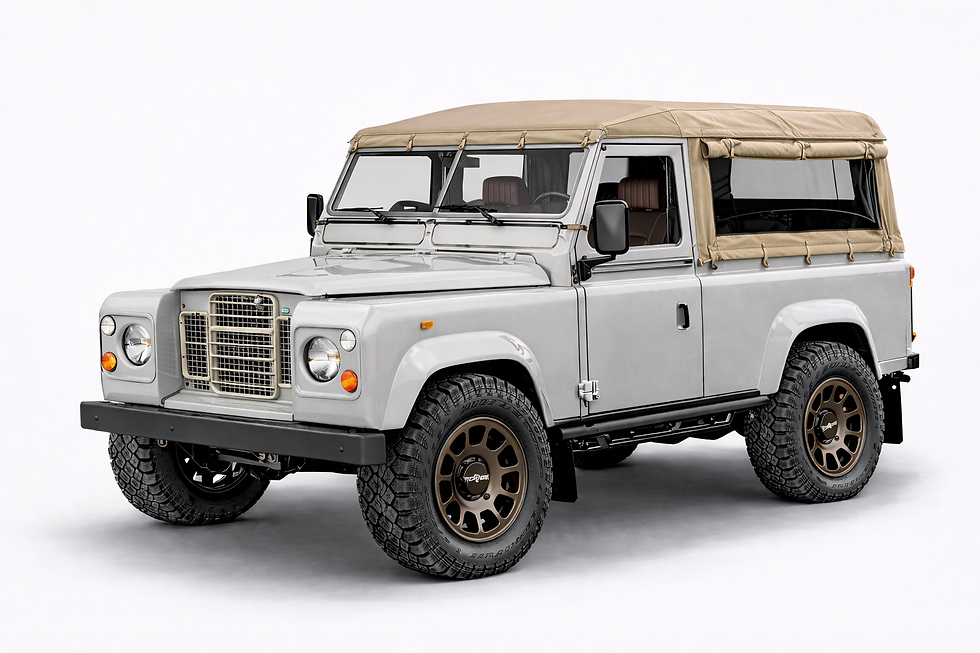
THE BUILD PROCESS
Defined up front.
Built the right way.
Every Rad-Rover project begins with clear scope, the right platform, and a powertrain architecture engineered for real use. From donor inspection to final commissioning, the process is built to protect performance, timeline, and investment.
WHY OWNERS CHOOSE RAD-ROVER OUTFITTERS
Nearly 100
Land Rover powertrain conversions completed
Ames, Iowa
Engineered and hand-built in-house
Defender + Series
90, 110, 130, Series II, and Series III platforms
Full integration
Fabrication, restoration, and driveline systems under one roof

PROCESS OVERVIEW
A build process with structure behind it.
A Rad-Rover build is not assembled around guesswork. We define how the vehicle will be used, inspect the platform it starts from, choose the correct engine and transmission strategy, and correct the foundation before major performance work begins.
Whether the project is a focused engine swap, a structural restoration, or a more complete custom build, every major decision is made with drivability, reliability, and long-term serviceability in mind.

STEP 01
Define the mission
Every successful build starts with clarity. We begin with a consultation to understand the vehicle, how you plan to use it, and what matters most to you—power, road manners, towing, compliance, long-distance touring, heritage character, or a full custom build experience.
From there, we define the early scope: platform, intended use, engine direction, transmission strategy, budget range, and build priorities.

Clear scope protects performance, timeline, and investment.
STEP 02
Source or inspect the right truck
Some projects begin with a donor vehicle you already own. Others begin with sourcing the right platform for the build ahead. In either case, the vehicle has to be suitable before major work starts.
We inspect the chassis, bulkhead, body condition, driveline condition, and overall starting point to determine what the truck needs structurally before powertrain integration begins.

The right build starts with the right foundation.
STEP 03
Lock the architecture
Once the platform is defined, we lock the mechanical direction of the project. That means choosing the engine platform, transmission pairing, cooling strategy, driveline geometry, wiring approach, exhaust path, and the level of refinement the build requires.
This is where the project becomes a system—not a collection of parts.

Powertrain choices should work together from day one.
STEP 04
Correct the foundation
Performance without structure fails. Before integration begins, the truck is corrected where it needs it most.
That can include chassis repair, rust remediation, suspension rebuilding, brake refinement, driveline correction, and the structural work required to make the vehicle worthy of modernization. Restoration at this stage is not cosmetic. It is foundational.

Foundation first. Power second.
STEP 05
Fabricate, integrate, and refine
With the platform corrected and the architecture defined, the build moves into fabrication and integration. Engine mounts, crossmembers, exhaust, cooling systems, electrical routing, and supporting components are built and installed around the vehicle—not forced into it.
This is where Rad-Rover’s systems-first approach matters most. The goal is not just to make the engine fit. The goal is to make the complete vehicle operate as a cohesive, reliable whole.

No improvisation. No universal-kit thinking.
STEP 06
Commission, test, and hand over
Completion is more than assembly. Every finished build must be sorted, checked, and validated before delivery.
The vehicle is road tested, reviewed, refined, and commissioned so the finished truck feels resolved—not merely finished. Handover happens when the vehicle is ready to be driven the way it was built to be used.

Built for real roads, not just the reveal.